Home · The Flyer
The machine
A canard biplane on skids
The museum describes the 1903 Wright Flyer as a canard biplane with one 12-horsepower Wright horizontal four-cylinder engine driving two pusher propellers via a sprocket-and-chain transmission, and with non-wheeled, linear skids as landing gear. [Smithsonian NASM] With the help of their bicycle-shop mechanic, Charles Taylor, the Wrights built a small, twelve-horsepower gasoline engine for the 1903 aircraft. [Smithsonian NASM]
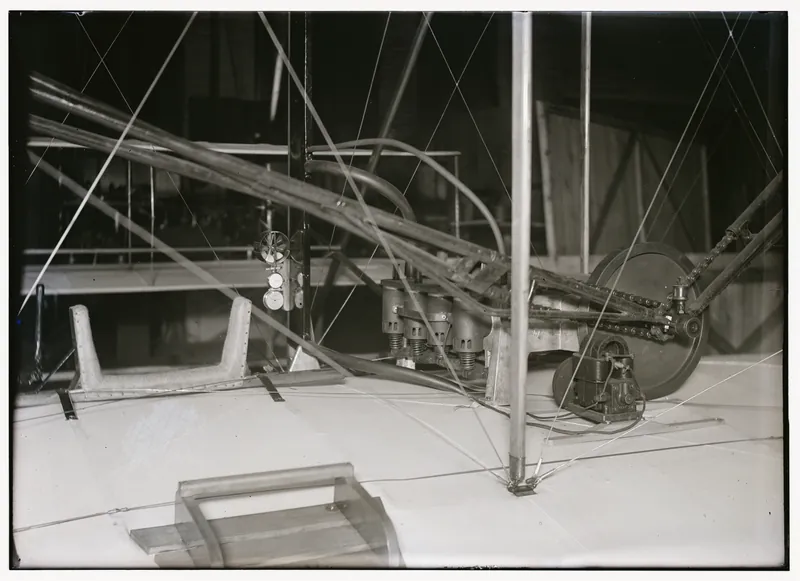
The Smithsonian’s published dimensions are a wingspan of 12.3 m (40 ft 4 in), a length of 6.4 m (21 ft 1 in), and a height of 2.8 m (9 ft 4 in). [Smithsonian NASM] The same object record gives an empty weight of 274 kg (605 lb) and a gross weight of 341 kg (750 lb). [Smithsonian NASM] The National Park Service, writing of the camp at the Kill Devil Hills, says the brothers mounted the engine on the new 40-foot, 605-pound Flyer with double tails and elevators. [NPS]
The Park Service’s “40-foot, 605-pound Flyer” and the Smithsonian’s 12.3 m (40 ft 4 in) wingspan, with an empty weight of 274 kg (605 lb), describe the same aeroplane. Forty feet is a rounded span. The empty weight matches. The museum also gives a gross weight of 341 kg (750 lb).
The airframe was wood, the fabric covering was muslin, and the engine crankcase was aluminium, according to the museum’s materials list. [Smithsonian NASM]
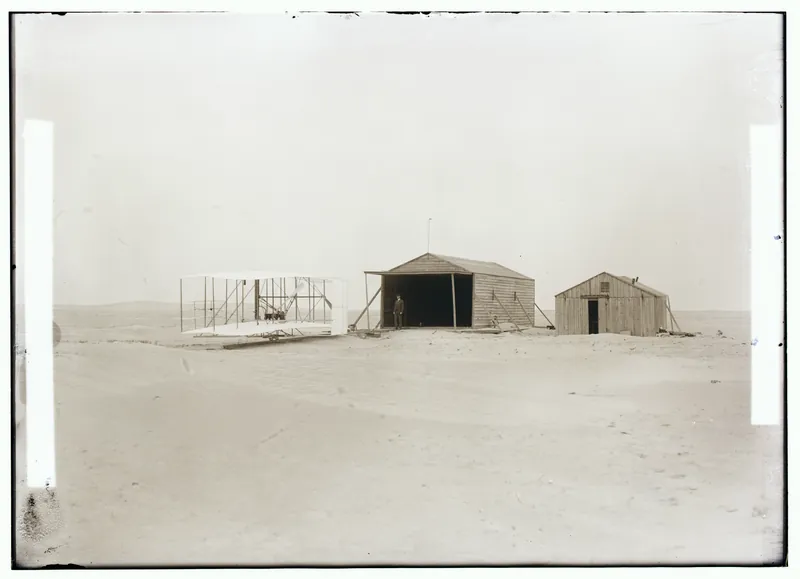
Because soft sand prohibited launching with conventional wheels, the wayside says the Wright Flyer was placed on a 60-foot monorail, with its landing skids resting on a wheeled truck. [NPS wayside]
The camp sat at the Kill Devil Hills, a few miles from the village of Kitty Hawk, which is where the telegram was sent. Both place names are historically right, used for slightly different spots on the same stretch of coast.