17 December 1903
The Wright Flyer, and the morning it left the rail
On a windy stretch of the North Carolina Outer Banks, Orville Wright flew 120 feet in 12 seconds. Open the flight-log desk to put the four flights of that morning next to a labelled wing-warping diagram, and to keep the National Park Service distances beside the Smithsonian’s wording when they differ.
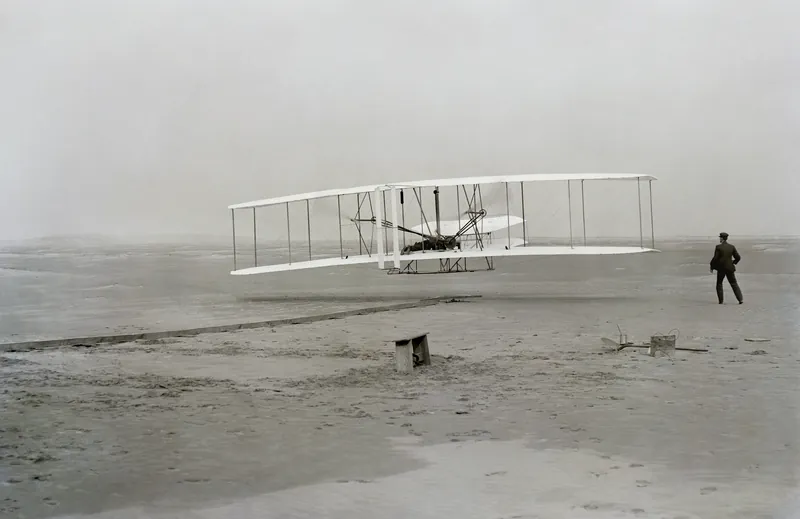
On 17 December 1903 at Kitty Hawk, North Carolina, the Wrights’ first powered airplane made a 12-second flight, travelling 36 m (120 ft), with Orville piloting. [Smithsonian NASM] The best flight of that day, with Wilbur at the controls, covered 255.6 m (852 ft) in 59 seconds, according to the National Air and Space Museum. [Smithsonian NASM]
Those two figures — the first hop and the long flight — are the ones almost everyone remembers. The memorial wayside also lists the two flights in between. The desk keeps all four, and it keeps the looser Smithsonian wording for the middle pair, rather than pretending the sources are identical.
The flight log
Times, distances and the machine, labelled, beside a wing-warping diagram.
17 December 1903
The coin toss the day before, the four flights, the photograph, and the gust.
The machine
A canard biplane, a twelve-horsepower engine, muslin, and skids.
Wing warping
A hip cradle, a front elevator, and tails that turned with the wings.