Home · 17 December 1903
Kill Devil Hills
Four flights in one morning
After winning a coin toss, Wilbur made an unsuccessful attempt on 14 December and damaged the Flyer slightly, before repairs were completed for 17 December. [Smithsonian NASM]
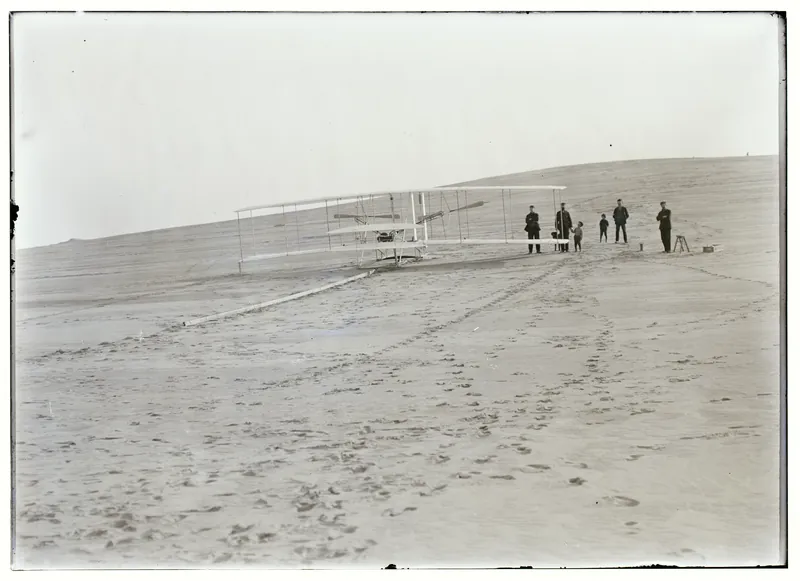
The photograph above is 14 December, on the slope of Big Kill Devil Hill, before that unsuccessful hop. The successful flights, three days later, were made from level sand.
The Park Service wayside at the memorial says the Wright brothers made four successful sustained powered flights the morning of 17 December 1903. [NPS wayside] On 17 December the Park Service records a 27-mph wind, harder than the Wrights would have liked, since their predicted cruising speed was only 30 to 35 mph. [NPS] At 10:35, Orville released the restraining wire, the Park Service writes, and the Flyer moved down the rail as Wilbur steadied the wings. [NPS] Just as Orville left the ground, John Daniels from the lifesaving station snapped the shutter on a preset camera. [NPS]
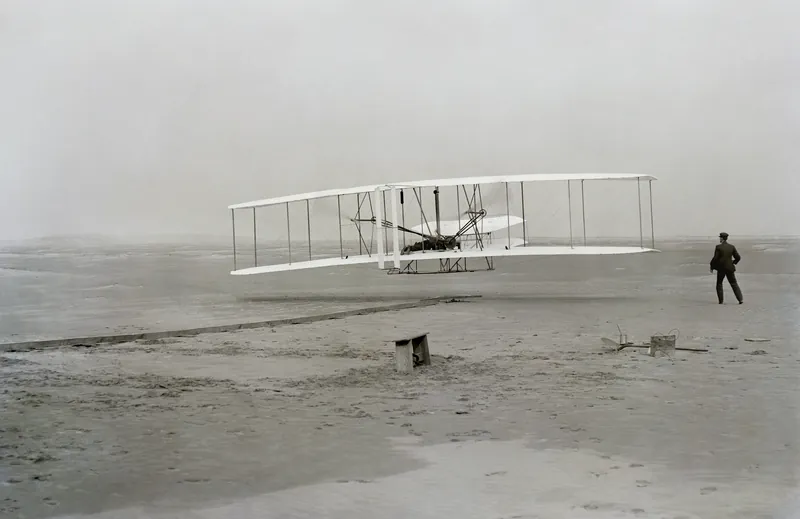
The Library of Congress says the famous first-flight photograph was made from a five-by-seven-inch glass-plate negative, on a camera Orville had set on a tripod, after he instructed John T. Daniels of the Kill Devil Hill Lifesaving Station how and when to snap the shutter. [Library of Congress] The same Library of Congress essay says this first flight lasted only twelve seconds and went 120 feet, and was followed by three more flights that day, each longer than the previous flight. [Library of Congress] On that first flight the machine hit the sand about 120 feet from the rail; into the 27-mph wind, the groundspeed had been 6.8 mph, for a total airspeed of 34 mph. [NPS]
That wayside records the four flights as 12 seconds and 120 feet; 12 seconds and 175 feet; 15 seconds and 200 feet; and, last, 59 seconds and 852 feet. [NPS wayside] The Smithsonian describes the second and third flights that morning as “in the range of two hundred feet,” with the brothers alternating as pilot. [Smithsonian NASM]
The wayside lists 175 feet and 200 feet for the second and third flights. The Smithsonian says those two were “in the range of two hundred feet.” Both wordings stay on this page.
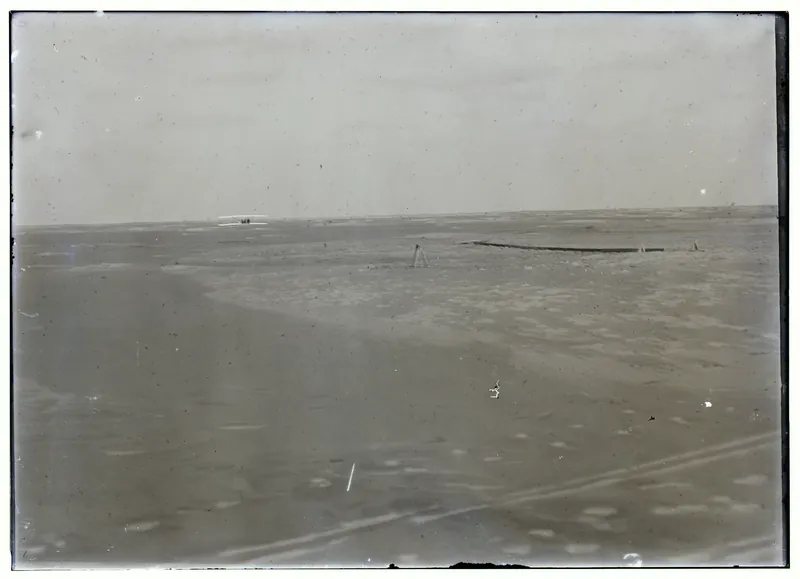
The best flight of that day, with Wilbur at the controls, covered 255.6 m (852 ft) in 59 seconds, according to the National Air and Space Museum. [Smithsonian NASM] Wilbur’s second flight — the fourth and last of the day — was, in the Park Service’s words, an impressive 852 feet in 59 seconds. [NPS]
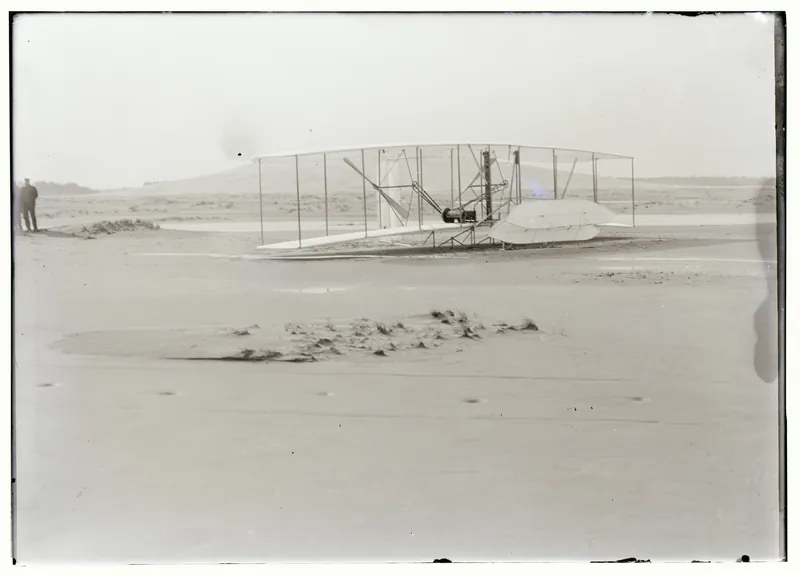
After the last flight, the Park Service says, the machine was caught by a gust of wind, rolled over, and damaged beyond easy repair. [NPS] As the brothers and the others present discussed the long flight, a gust of wind overturned the Wright Flyer and sent it tumbling across the sand; the aircraft was severely damaged and never flown again, says the Smithsonian. [Smithsonian NASM]
The close photograph of the damaged elevator is from after the fourth landing, and before the gust that rolled the machine over.
Two errors were made in the transmission of the telegram to Milton Wright: Orville’s name was misspelled, and the time of their longest flight was given as fifty-seven instead of fifty-nine seconds. [Library of Congress] The telegram reached Dayton, Ohio, at 5:25 p.m., and the brothers returned home with their broken machine on the evening of 23 December. [Library of Congress]
For the controls that made the turns possible, see wing warping, or open the flight-log desk.